
‘Academic journals are a lucrative scam’
Arash Abizadeh, in a sharp Guardian piece—a follow up to the mass resignation of Abizadeh and co-editors from Wiley’s Philosophy & Public Affairs:
[…] as editors of one of our field’s leading journals, we feel a strong responsibility to help build collective momentum towards a better arrangement: a publishing model that no longer wastes massive amounts of public resources feeding profits to private corporations, secures editorial independence against the pressures of profit-making and makes research available to everyone, free of charge. This isn’t just an academic problem. A revolution in the publishing landscape could also help stem the tide of disinformation and propaganda in the public sphere. Such an alternative is available, but it’s hard to get there. We want to change that.
Abizadeh and co. are—like some other corporate-journal refugees—re-launching with the Open Library of Humanities. The piece itself is a cleanly written precis of the stakes and solutions—one of many over the years, but we need them to keep coming.
‘Empowering knowledge through AI: open scholarship proactively supporting well trained generative AI’
Beth Montague-Hellen, in an interesting Insights piece:
When discussing AI, much time has been spent on identifying how the technology can be of use, where it might be dangerous and how we may want to restrict or enable it. There has been considerable discussion about restricting the use of copyrighted material within training datasets and how the use of this material may be breaking existing copyright laws. However, little time has been spent discussing the more positive issue of which materials we would like generative AI to have access to. This article proposes that scholarly communications professionals, including librarians and publishers, should be pushing for the inclusion, rather than the exclusion, of scholarly content in AI training datasets.
It’s fascinating to watch the open-everything ethos of the OA movement contend with the AI training question. Here Montague-Hellen applies the movement’s logic to AI: Of course we should make it easier for models to train on published scholarship. There is, at the same time, lots of unease with the big-tech profiteering off of scholars’ work—a concern I share. Montague-Hellen’s main rationale is to save the big models’ from their hallucination problem, on the grounds that scholarship is vetted, unlike the cesspool of the internet they’ve been trained on. But do we want to help Google, OpenAI, Microsoft, Apple and the rest to take still further control of the knowledge ecosystem? It’s the absence of any serious engagement with big tech—and no mention of the scholarly publishing oligopoly, which thinks it’s sitting on a gold mine—that makes a piece like this come off as a bit naive.
Either way, the tension between open-everything and stop-profiting-off-consentless-extraction is coming more and more into focus. And there are echoes, with this AI-training question, of the old CC BY vs. CC BY-NC wars in open licensing—even if, in the AI case, it’s not clear that even CC BY permits it. The question in common is whether by “open” we mean “open to profit.”
‘The importance of JATS XML in scholarly publishing’
PKP’s Alec Smecher, with a great layman’s-terms overview of JATS XML:
While it has been hard for publishers with limited resources to adopt, and there is an exclusionary aspect to that, JATS has forced scholars to consider what scholarly documents are made out of, how we produce them through processes like peer review, and how we describe them. In that sense, JATS is a tremendous piece of meta-science. It is often at the center of the scholarly publishing ecosystem pushing for improvement.
‘A two-sided marketplace for publishers and AI companies’
Axios, from March, on a startup that’s building a marketplace for publishers to sell their content for AI training:
TollBit, co-founded by Toast alumni Olivia Joslin and Toshit Panigrahi, basically lets publishers make their verified content available to AI companies, for a fee. Those fees can be dynamic — based on keyword prompt trends, for example — with TollBit providing both sides with pricing insights.
This is, in a way, what the Copyright Clearance Center (CCC) does, but with training uses in mind. You can imagine the big scholarly publishers signing on to what could look like the rapid-fire, automated ad marketplaces of the 2000s—dynamic pricing and all.
‘The Publication Facts Label’
A fascinating idea and project from the estimable Public Knowledge Project (PKP):
We are calling it a publication facts label (PFL). It is intended to appear with each research article [and] emulates the look and feel of the Nutrition Facts label on food products in the United States. At this point in its development, the PFL draws data and links from the journal’s publishing platform on eight critical elements for scholarly publishing and presents to readers: (a) the publisher’s identity; (b) the journal’s scholarly editorial oversight; (c) the journal’s article acceptance rate; (d) the indexing of the journal; (e) the article’s number of peer reviewers and reviewer backgrounds; (f) the article authors' competing interests; (g) the research study’s data availability; and (h) the funders of the research.

The Learned Publishing overview (co-authored by PKP founder John Willinsky) continues:
The PFL is intended to assemble facts about the editorial process and the backgrounds of those involved. It is meant to present those facts on articles in every field across all journals in a common format that can be readily consulted when a question arises about a work or the publication.
It’s a clever idea. See also this PKP post that includes links to interviews and writeups.
‘Academic publishers: The original enshittificationists’
Matt Wall on Medium, applying Cory Doctorow’s theory of enshittification to scholarly publishers:
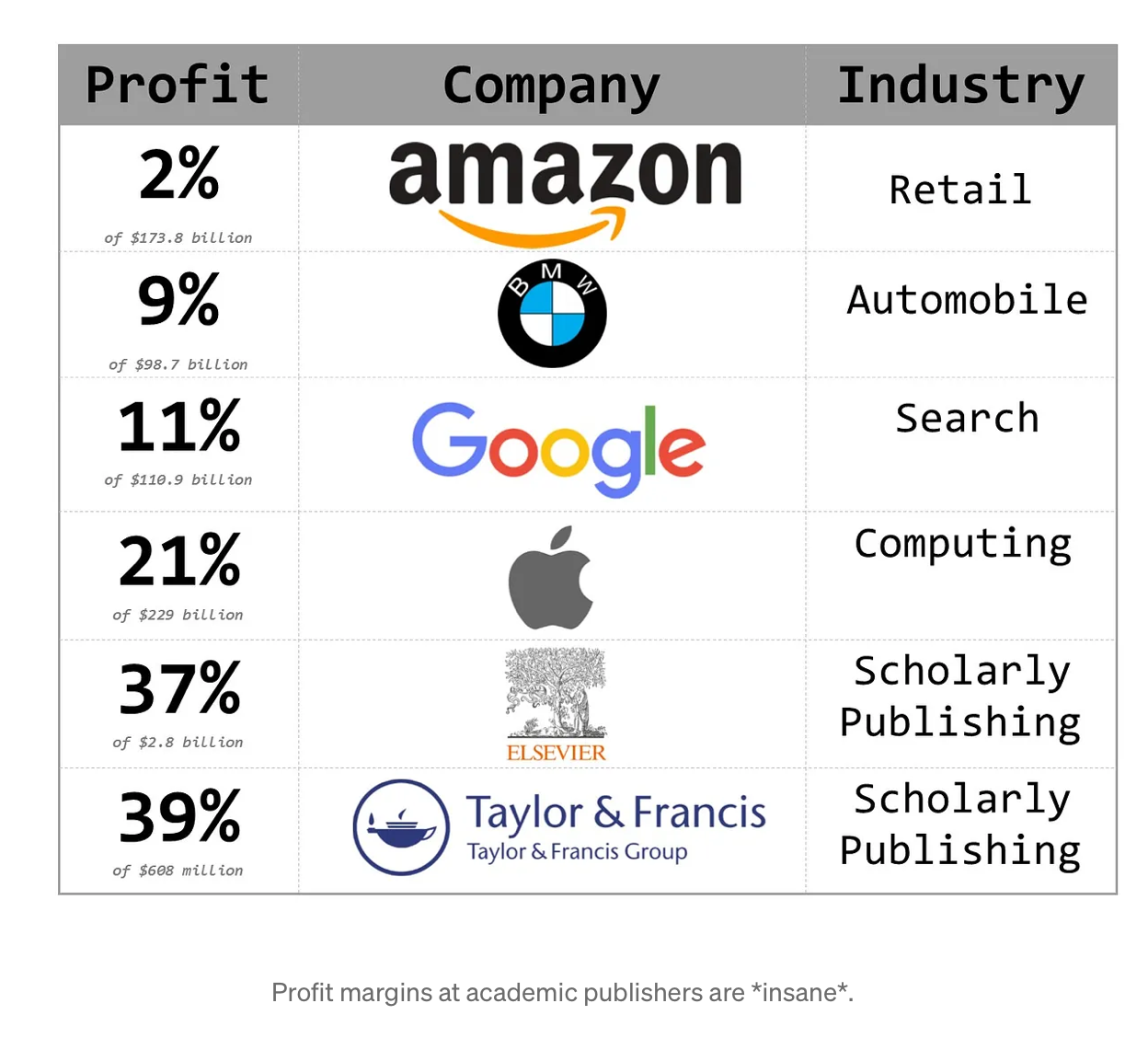
Here’s the thing though, the final part of Doctorow’s enshittification process as applied to online platforms is “then they die”. There currently seems to be little evidence of that. The outright profiteering and blatant exploitation of researchers has arguably shifted up a gear in the last couple of decades with the advent of open-access fees, but this process has been going on since the 1970s; academic publishers are the original enshittificationists (enshittifiers?). They have kept on re-inventing ways of enshittifying the process of disseminating scholarly information and maintaining their grossly-inflated profit margins, most notably by co-opting the open-access movement and using it as an excuse to charge ridiculous publication fees. They are a leech on the body of scholarly work, slowly sucking out the life-blood, but just never quite enough that researchers and institutions abandon them wholesale. My feeling is that they will continue doing so for many decades into the future.
jeff.pooley@asc.upenn.edu
jpooley@mediastudies.press
CV
Publications
@jpooley@scholar.social
Orcid
Knowledge Commons
Google Scholar
Projects
mediastudies.press
A non-profit, scholar-led publisher of open-access books and journals in the media studies fields
Co-director
History of Media Studies
An open access, refereed academic journal
Founding co-editor
History of Social Science
A refereed academic journal published by the University of Pennsylvania Press
Founding co-editor
Journal of Communication Forum
The Journal of Communication’s review-essay section
Co-editor
Annenberg School for Communication Library Archives
Archives consulting, Communication Scholars Oral History Project, and History of Communication Research Bibliography
Consultant
MediArXiv
The open archive for media, film, & communication studies
Founding co-coordinator