
‘Neither Artificial nor Intelligent’
Sue Curry Jansen and I, in a double review of Kate Crawford's Atlas of AI (Yale, 2021) and Frank Pasquale's The New Laws of Robotics (Harvard, 2020):
What Crawford and Pasquale draw out is that AI is a way of seeing the world—a lay epistemology. When we see the world through the lens of AI, we see extraction-ready data. We see countable aggregates everywhere we look. We’re always peering ahead, predicting the future with machinist probabalism. It’s the view from Palo Alto that feels like a god’s eye view. From up there, the continents look patterned and classification-ready. Earth-bound disorder is flattened into clear signal. What AI sees, in Crawford’s phrase, is a “Linnaean order of machine-readable tables.” It is, in Pasquale’s view, an engineering mindset that prizes efficiency over human judgment.
The piece appears in The b2o Review.
‘The State of Journal Production and Access 2020’
From Scholastica's 2020 "State of Journal Production and Access" report:
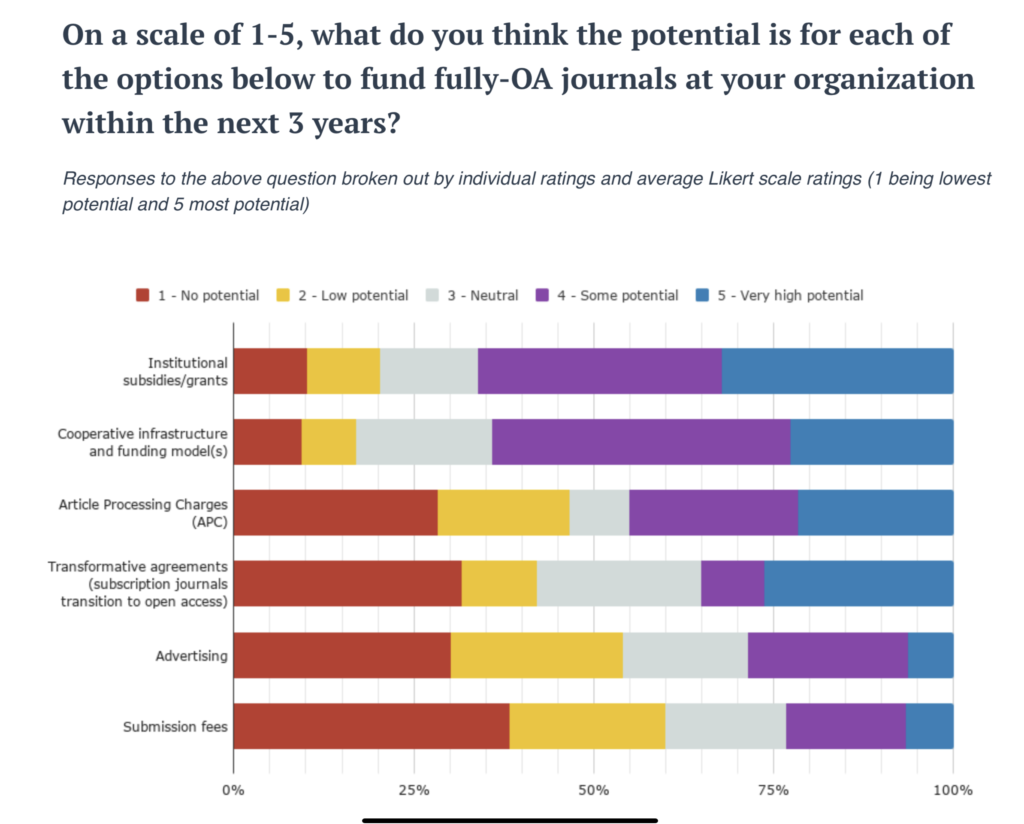
Transformative agreements were a lower rated option, with 54% of survey respondents selecting “low” or “no” potential and only 32% of respondents selecting “some” or “very” high potential.
Scholastica, a small for-profit journal-hosting platform, surveyed 63 society and university publishers on, among other things, the "potential" of various funding options. The chart:
‘Next steps for the Open Book Collective’
The good people at COPIM, in their formal announcement of the Open Book Collective:
OBC will act as a collector of revenues accrued for new membership packages from institutions – primarily academic libraries – with this revenue then passed on to OA book publishers and infrastructure providers. A portion of the revenue will be retained to cover the platform’s administrative overhead costs.
The Open Book Collective, when it's launched in the spring, will help solve the APC/BPC author-exclusion problem, by directly linking funders to publishers (and infrastructure stewards). I see the OBC as the book counterpart to the journal-centric OACIP from LYRASIS. They are—in practice, in OACIP's case, and in active development, now, for OBC—the two main examples of the mission-aligned funding exchange.
‘Positively Disrupt(ing) Research Culture for the Better’
Alexandra Freeman, in an August Scholarly Kitchen interview about her new publishing platform Octopus:
Of course people can publish elsewhere as well. I suspect in the short term Octopus will act a bit like a preprint server in that respect. Authors will hopefully want to publish quickly in Octopus to ensure they get the credit for their work as soon as possible, protecting their “priority” over it, but then write it up for a traditional journal at some point. In the longer term I think that second stage will modify, so that journals will not be taking primary research papers and organizing peer review, but instead be commissioning reviews, syntheses, editorials, and short “news” articles announcing findings — so authors will instead be pitching those once they have published in Octopus.
There's lots to digest about Octopus, including its modular model. What's most interesting about Freeman's interview, though, is her vision for the future of journals. Plainly influenced by her background in media (and science journalism in particular), she sees journals moving toward public- or professional-facing summary pieces, with the soup-to-nuts details for fellow specialists hosted on Octopus or its future peers:
It struck me that journals are trying to fulfill two roles at once in the current system. On the one hand they are disseminating important findings to their readers, particularly to professionals who may be able to implement those findings in practice. On the other hand they have the somewhat thankless task of being the primary research record, where researchers publish all their work in all detail to a minority readership. These two roles pull in opposite directions: an article that gives full details, all the twists and turns and blind alleys of the real research process, does not make a nice, easily-digested narrative for those who mainly want to know the findings and implications; an article that supplies the ‘edited highlights’ does not give the full details that other researchers need to learn from. Journal articles are best suited to the dissemination role — the “news and views” and editorialized, narrative-driven pieces.
It's an interesting vision for the division of publishing labor—readable digests, separated out from the weedier research record. Freeman just got £650,000 from Research England to build out her end: Octopus is slated to launch in spring 2022.
‘Africa and Latin America agree to closer collaboration around open science’
Speaking of the draft UNESCO recommendations, I missed this April announcement:
Today, LA Referencia, RedCLARA and the three African regional research and education networks – ASREN, WACREN and UbuntuNet Alliance – signed a Memorandum of Understanding (MoU) to formalize their relationship as the two continents seek to ramp up their open science activities. The aim of the collaboration is to advance open science policies, services and infrastructure that reflect the unique needs and conditions of each continent within a framework of international cooperation.
I'm sensing growing momentum around South-South cooperation to challenge the APC model that's taken partial hold in Europe and North America. Last week's OASPA conference featured a fiery talk by Reggie Raju, a librarian at the University of Cape Town.
‘Library Support for OA Books Workshop: the Scandinavian perspective’
Agata Morka, reporting last year on an OA-books funding workshop:
In the Nordic countries, there are official lists, with separate ratings for journals and for book publishers (Norwegian one (also used in Sweden), Danish and Finish [sic] one). They are used in various ways: some institutions might require their researchers to only publish with top rated publishers from these lists, some might use it as a point of reference in evaluating their institution’s publishing output, and some might steer their researchers towards them in the search for trustworthy publishers. The lists themselves, as well as practices surrounding the evaluation/inclusion processes remain controversial. According to the Finnish list, operating on a 0-3 scale (0=under evaluation, 1=basic, 2=leading, 3=top) there are 13 leading book publishers in the world, with usual suspects included: a bunch of Ivy League university presses and commercial giants like Palgrave Macmillan or Routledge.
Deflating, if unsurprising.
jeff.pooley@asc.upenn.edu
jpooley@mediastudies.press
CV
Publications
@jpooley@scholar.social
Orcid
Knowledge Commons
Google Scholar
Projects
mediastudies.press
A non-profit, scholar-led publisher of open-access books and journals in the media studies fields
Co-director
History of Media Studies
An open access, refereed academic journal
Founding co-editor
History of Social Science
A refereed academic journal published by the University of Pennsylvania Press
Founding co-editor
Journal of Communication Forum
The Journal of Communication’s review-essay section
Co-editor
Annenberg School for Communication Library Archives
Archives consulting, Communication Scholars Oral History Project, and History of Communication Research Bibliography
Consultant
MediArXiv
The open archive for media, film, & communication studies
Founding co-coordinator